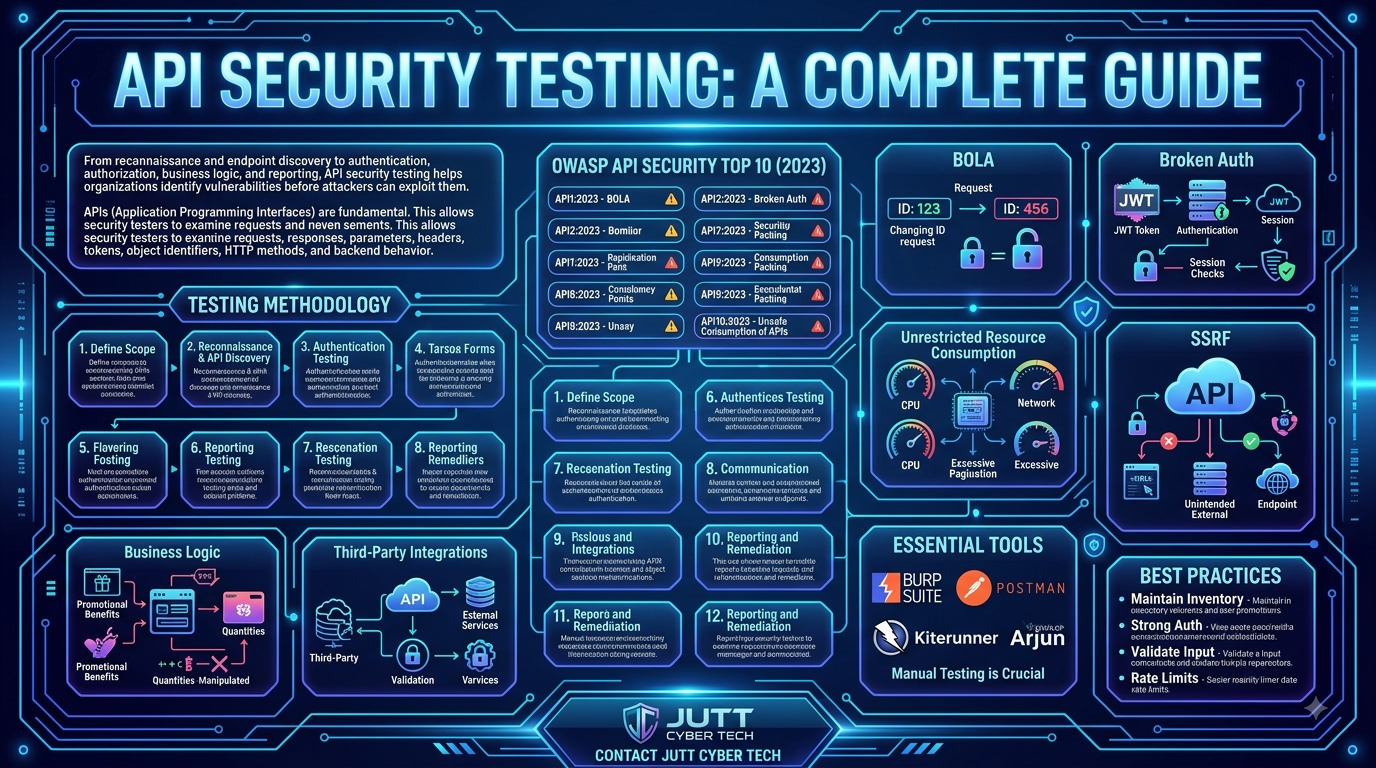
From reconnaissance and endpoint discovery to authentication, authorization, business logic, and reporting, API security testing helps organizations identify vulnerabilities before attackers can exploit them.
APIs (Application Programming Interfaces) are fundamental to modern web applications, mobile applications, microservices, cloud platforms, and third-party integrations. They allow systems to exchange data and perform actions programmatically, but they can also expose sensitive functionality and data when security controls are improperly implemented.
API security testing is therefore an important part of application security. A thorough assessment examines not only individual endpoints, but also authentication, authorization, input validation, business logic, resource consumption, API configurations, integrations, and the overall API inventory.
What Is API Security Testing?
API security testing is the process of assessing APIs for vulnerabilities, insecure configurations, authorization weaknesses, authentication flaws, data exposure, injection issues, and business-logic weaknesses.
Unlike traditional browser-focused web application testing, API testing interacts directly with the application's programmatic interfaces. This allows security testers to examine requests, responses, parameters, headers, tokens, object identifiers, HTTP methods, and backend behavior.
A proper API security assessment should determine whether an API:
- Properly authenticates users and services.
- Enforces authorization for every protected resource and function.
- Prevents unauthorized access to other users' objects or data.
- Validates and safely processes input.
- Limits resource-intensive operations.
- Protects sensitive information in requests and responses.
- Handles errors without unnecessarily revealing internal information.
- Properly secures third-party API integrations.
- Maintains an accurate inventory of API endpoints and versions.
- Protects sensitive business operations from automated abuse.
OWASP's API Security Testing guidance emphasizes understanding the API technology and systematically testing its security behavior rather than relying only on automated scanning.
OWASP API Security Top 10
The OWASP API Security Top 10 (2023) identifies ten major API security risks. It is an important reference for developers, security engineers, and penetration testers when assessing API security.
API1:2023 — Broken Object Level Authorization (BOLA)
BOLA occurs when an API fails to properly verify whether an authenticated user is authorized to access a specific object.
For example, an API may provide:
GET /api/users/123If changing the object identifier to another value allows one authenticated user to access another user's private information, the endpoint may have a broken object-level authorization vulnerability.
The important point is that changing an ID alone does not prove BOLA. The tester must establish that the authenticated user can access or modify an object belonging to another user without the required authorization.
Object-level authorization checks should be applied whenever an API uses user-controlled identifiers to access or modify objects.
API2:2023 — Broken Authentication
Broken authentication occurs when an API incorrectly implements mechanisms used to identify and authenticate users or services.
Testing should examine areas such as:
- Login and authentication flows.
- Password policies and credential handling.
- Access tokens and session tokens.
- JWT validation and expiration.
- Refresh-token handling.
- API keys.
- Authentication bypass conditions.
- Token revocation and logout behavior.
- Authentication error handling.
Weak authentication can allow attackers to impersonate legitimate users or gain unauthorized access.
API3:2023 — Broken Object Property Level Authorization
This vulnerability occurs when an API does not properly control access to individual properties or fields within an object.
For example, an API may allow users to update their profile using a JSON request such as:
{"name":"Alice","email":"[email protected]"}If security-sensitive properties such as administrative roles or account status can also be modified without proper authorization, the API may have an object property authorization weakness.
This category incorporates risks previously associated with excessive data exposure and mass assignment, focusing on authorization at the property level.
API4:2023 — Unrestricted Resource Consumption
APIs consume resources such as CPU, memory, network bandwidth, storage, and database capacity.
Security testing should determine whether attackers can abuse resource-intensive functionality through:
- Excessively large requests.
- Large file uploads.
- Expensive database queries.
- Excessive pagination.
- Resource-intensive search operations.
- Repeated SMS or email requests.
- Expensive third-party API calls.
- Computationally expensive operations.
The impact can range from denial of service to unexpected infrastructure or third-party service costs.
API5:2023 — Broken Function Level Authorization
Function-level authorization controls whether a user is allowed to perform a particular action.
For example, an application may correctly authenticate a normal user but incorrectly allow that user to call an administrative endpoint.
Security testing should verify access to:
- Administrative functions.
- User-management operations.
- Privileged API endpoints.
- Create, update, and delete operations.
- Internal or restricted functionality.
Authorization should be enforced server-side rather than relying on the client application to hide privileged functionality.
API6:2023 — Unrestricted Access to Sensitive Business Flows
Some API functionality may be legitimate but dangerous when automated at scale.
Examples include:
- Account creation.
- Ticket purchasing.
- Password-reset requests.
- Promotional-code redemption.
- Comment or review submission.
- OTP or verification requests.
- Resource reservation.
Security testing should determine whether sensitive business processes have appropriate protections against automated abuse.
This risk is different from a traditional technical vulnerability because the API may function exactly as designed while still allowing an attacker to abuse the underlying business process. OWASP specifically introduced this category in the 2023 edition.
API7:2023 — Server-Side Request Forgery (SSRF)
SSRF can occur when an API retrieves a resource based on a user-controlled URL or URI without sufficiently restricting where the server is allowed to connect.
Security testing should examine functionality such as:
- Webhook URLs.
- URL preview services.
- Remote file imports.
- Image or document fetchers.
- External integrations.
- Callback functionality.
The primary security question is whether an attacker can manipulate server-side requests to reach destinations that should not be accessible.
API8:2023 — Security Misconfiguration
API security can be weakened by insecure configuration rather than application-code vulnerabilities.
Testing should examine:
- Unnecessary HTTP methods.
- Debug functionality.
- Default credentials.
- Verbose error messages.
- Incorrect CORS configuration.
- Missing security headers where applicable.
- Insecure TLS configuration.
- Exposed administrative interfaces.
- Unnecessary services.
- Development or staging endpoints.
- Improperly configured API gateways.
Security configuration should follow the principle of least exposure.
API9:2023 — Improper Inventory Management
Organizations often have more APIs than they realize.
An assessment should identify:
- Production APIs.
- Development and staging APIs.
- Deprecated API versions.
- Legacy endpoints.
- Shadow APIs.
- Debug endpoints.
- Different API hosts.
- Different versions such as
/v1/,/v2/, and/v3/.
An outdated API inventory can leave forgotten endpoints exposed with weaker security controls.
OWASP specifically highlights the importance of maintaining an accurate inventory of API hosts, deployed versions, and documentation.
API10:2023 — Unsafe Consumption of APIs
APIs frequently depend on external APIs and third-party services.
A common mistake is to trust data received from another API simply because it came from an established provider.
Security testing should examine whether third-party responses are:
- Properly validated.
- Safely parsed.
- Transported securely.
- Subject to appropriate authentication.
- Protected against unexpected redirects.
- Subject to reasonable timeouts and resource limits.
Unsafe consumption of external APIs can potentially introduce data exposure, injection vulnerabilities, or denial-of-service conditions into the consuming application.
API Security Testing Methodology
A structured methodology helps testers achieve consistent and reproducible results.
1. Define the Scope
Before testing begins, identify the systems and API functionality that are authorized for assessment.
Document:
- API domains and hosts.
- API versions.
- Authentication mechanisms.
- User roles.
- Test accounts.
- API documentation.
- In-scope endpoints.
- Out-of-scope systems.
- Testing limitations.
Security testing should only be performed against systems where appropriate authorization has been obtained.
2. Reconnaissance and API Discovery
The first technical phase is understanding the API attack surface.
Sources for API discovery can include:
- OpenAPI or Swagger documentation.
- Mobile and web application traffic.
- API gateway configurations.
- JavaScript files.
- Existing API documentation.
- Endpoint discovery tools.
- Parameter discovery tools.
Tools such as Kiterunner and Arjun can assist with endpoint and parameter discovery, while an intercepting proxy can help identify API requests generated by applications.
The goal is to build an accurate map of endpoints, methods, parameters, authentication requirements, and response behavior.
3. Authentication Testing
Evaluate how the API identifies users and services.
Test areas include:
- Login mechanisms.
- Password policies.
- API keys.
- Bearer tokens.
- JWT implementation.
- Token expiration.
- Refresh tokens.
- Session invalidation.
- Authentication bypass.
- Missing authentication on sensitive endpoints.
The objective is to determine whether authentication controls reliably establish the identity of the requester.
Conclusion
APIs are a critical part of modern software infrastructure, but their direct access to application functionality and data makes them an important security boundary. Effective API security testing requires more than scanning endpoints for known vulnerabilities. It requires understanding authentication, authorization, business logic, data exposure, resource consumption, configuration, API inventory, and third-party integrations. Using the OWASP API Security Top 10 as a baseline and combining automated tools with manual testing can help organizations identify weaknesses before they become security incidents.
At Jutt Cyber Tech, we provide security-focused assessments designed to identify API vulnerabilities, authorization weaknesses, configuration issues, and other risks across modern application environments.
If you need help assessing the security of your APIs, contact Jutt Cyber Tech to discuss your security assessment requirements.