Artificial intelligence is not replacing traditional cyberattacks. It is changing the economics and speed of how those attacks are conducted.
In 2026, threat intelligence reporting shows attackers using AI for information gathering, highly convincing phishing, malware development, vulnerability exploitation, and increasingly automated attack workflows. Google Threat Intelligence Group has reported AI-assisted operations involving vulnerability discovery, exploit generation, and initial access, while other research has documented threat actors deploying local AI models, coding assistants, retrieval systems, and AI-agent frameworks.
The important shift is not that AI has invented completely new attack categories.
The important shift is that tasks that previously required significant human time can increasingly be performed faster, at greater scale, and with less manual effort.
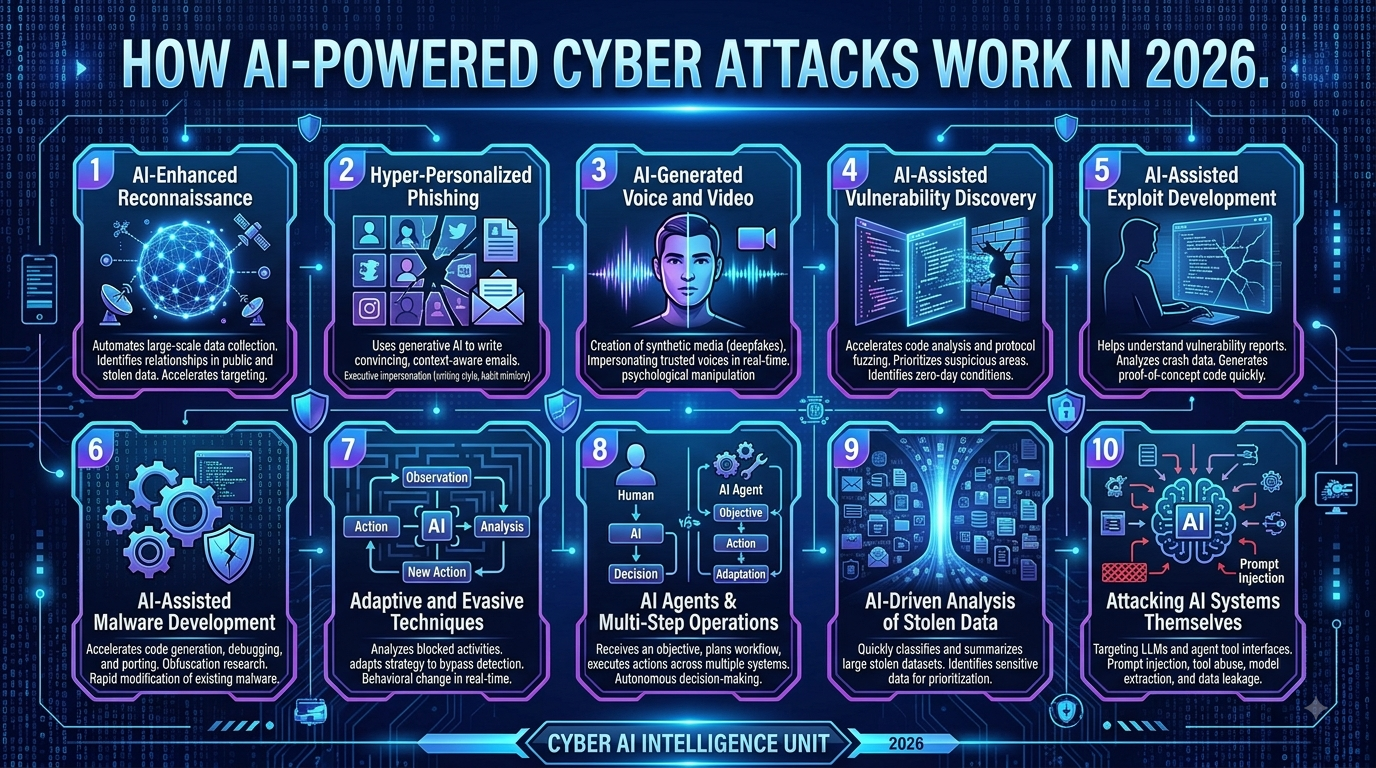
1. AI-Enhanced Reconnaissance
Reconnaissance is the first stage of many cyberattacks.
Attackers collect information about:
- Employees
- Domains
- Technologies
- Public infrastructure
- Email addresses
- Software versions
- Organizational relationships
- Public documents
- Previously exposed information
AI can make this process considerably more efficient by processing large amounts of information and identifying relationships that would take a human much longer to discover.
How It Works
A traditional attacker might manually search public sources and create a target profile.
An AI-assisted workflow can help organize and correlate that information automatically.
For example:
Public Information
       ↓
Data Collection
       ↓
AI-Assisted Analysis
       ↓
Target Identification
       ↓
Attack Preparation
The important point is that AI is not necessarily collecting every piece of information itself. It can instead help an attacker process, summarize, classify, correlate, and prioritize information that has already been obtained.
Google Threat Intelligence Group has reported threat actors using AI for information gathering and operational support.
2. Hyper-Personalized Phishing and Social Engineering
Phishing remains one of the most practical uses of generative AI.
AI allows attackers to produce convincing messages quickly while adapting the content to a specific target, organization, language, or situation.
Generic phishing has not disappeared. The difference is that producing highly personalized phishing no longer requires the same amount of manual work.
AI-Assisted Spear Phishing
An attacker may combine public information, stolen information, and previously collected intelligence to create a target profile.
AI can then assist with:
- Writing convincing emails
- Adapting language and tone
- Translating messages
- Creating realistic business context
- Generating fake documents
- Producing multiple variations of the same campaign
Google has observed threat actors using AI to create highly realistic phishing content.
Executive Impersonation
A particularly dangerous scenario is impersonating an executive or trusted employee.
An attacker may attempt to imitate:
- Writing style
- Vocabulary
- Communication habits
- Voice
- Appearance
- Business context
The objective is usually not to perform a sophisticated technical exploit.
It is to convince a legitimate person to perform a dangerous action.
Examples include:
- Changing payment details
- Resetting credentials
- Sharing confidential information
- Approving a transaction
- Installing software
- Providing access to an internal system
3. AI-Generated Voice and Video
Synthetic media adds another layer to social engineering.
Modern systems can generate convincing synthetic speech and video, although the quality depends on the model, available source material, recording conditions, language, and other factors.
Attackers can use synthetic media to impersonate trusted individuals during social-engineering attempts.
Why This Matters
A traditional phishing attack might be detected because the message looks suspicious.
A voice call from someone who appears to be a trusted executive creates a different psychological situation.
The victim may think:
“I recognize the voice, so this must be legitimate.”
That assumption is dangerous.
Voice or video should therefore not be treated as sufficient proof of identity for high-risk actions.
For financial transfers, credential resets, privileged access changes, or other sensitive operations, organizations should use independent verification channels and strong authorization procedures.
4. AI-Assisted Vulnerability Discovery
One of the most important developments is the use of AI in vulnerability research.
Security researchers and attackers can use AI to help analyze:
- Source code
- Program behavior
- Protocols
- Dependencies
- Crash data
- Logs
- Memory artifacts
- Public vulnerability information
AI can help prioritize suspicious areas and accelerate analysis.
AI-Guided Fuzzing
Traditional fuzzing automatically supplies large numbers of inputs to software and observes crashes or abnormal behavior.
AI-assisted systems can use program feedback to prioritize potentially interesting execution paths or inputs.
The goal is not simply to generate more input.
The goal is to spend computational resources more intelligently.
This area includes research involving machine learning and reinforcement-learning approaches, although capabilities and effectiveness vary substantially between systems.
5. AI-Assisted Exploit Development
Exploit development remains difficult, but AI is making parts of the process faster.
An AI system can assist with:
- Understanding vulnerability reports
- Analyzing source code
- Reviewing crash information
- Identifying likely exploitation conditions
- Generating proof-of-concept code
- Adapting existing research to a different environment
Importantly, not every AI-generated proof of concept works.
Real exploitation still depends on the vulnerability, target environment, mitigations, architecture, available privileges, and many other factors.
However, the time required to move from vulnerability information toward a working proof of concept can be reduced.
In May 2026, Google Threat Intelligence reported identifying a threat actor using a zero-day exploit that investigators believed had been developed with AI. This is an important distinction: AI-assisted exploit development is no longer purely theoretical.
6. AI-Assisted Malware Development
AI can also accelerate malware development.
The important change is not necessarily that attackers are creating completely autonomous “AI malware.”
A more realistic description is that attackers can use AI to accelerate parts of malware development and modification.
AI can assist with:
- Code generation
- Debugging
- Porting code
- Obfuscation research
- Error correction
- Documentation analysis
- Tool development
- Modification of existing malware
Google has reported observing threat actors using AI to develop malware, while reporting on Kimsuky has described the use of local AI models, coding assistants, retrieval systems, and AI-agent frameworks in cyber operations.
Why Local AI Models Matter
Threat actors may prefer locally operated models because they can provide greater control over data and reduce dependence on external AI services.
Local models can potentially be combined with:
- Internal datasets
- Stolen information
- Custom tools
- Retrieval systems
- Coding environments
- Automated workflows
This creates an environment in which AI becomes part of the attack infrastructure rather than simply a chatbot used by an individual attacker.
7. Adaptive and Evasive Attack Techniques
Attackers constantly attempt to avoid detection.
AI can assist with adapting malicious activity based on observed responses.
For example, an automated system could analyze whether an activity was blocked and change its next action accordingly.
Conceptually:
Action
  ↓
Observation
  ↓
AI Analysis
  ↓
Change Strategy
  ↓
New Action
  ↓
Observation
This is important because many traditional security controls assume relatively predictable attacker behavior.
Adaptive systems can make that assumption weaker.
However, claims that AI has already made traditional antivirus or signature detection “obsolete” are incorrect.
Signature-based detection remains useful.
The real problem is that signatures alone are insufficient against rapidly changing or previously unseen threats.
Modern defense therefore requires multiple layers, including behavioral detection, endpoint telemetry, reputation systems, sandboxing, threat intelligence, and other controls.
8. AI Agents and Multi-Step Cyber Operations
This is arguably the most important development in 2026.
A traditional AI assistant normally waits for a human to give it a task.
An AI agent can instead:
- Receive an objective
- Gather information
- Analyze the results
- Select the next action
- Use available tools
- Observe the result
- Adjust its strategy
- Continue the workflow
The difference can be represented as:
Traditional AI Assistance

Human
 ↓
AI Suggestion
 ↓
Human Decision
 ↓
Human Action
versus:
Agentic Workflow

Human Objective
      ↓
AI Agent
      ↓
Reconnaissance
      ↓
Analysis
      ↓
Action
      ↓
Result
      ↓
Adaptation
      ↓
Next Action
The security significance is obvious.
A human attacker can perform only a limited number of actions manually.
An automated system can potentially process many targets and decisions much faster.
Google reported in May 2026 that threat activity was moving toward broader industrial use of generative AI in adversarial workflows, including vulnerability exploitation and initial access.
Research published in 2026 has likewise highlighted the ability of agentic systems to plan, inspect code, interact with web applications, call tools, and coordinate multi-step workflows.
9. AI-Driven Analysis of Stolen Data
Obtaining data is only part of an attack.
Attackers must also determine which information is useful.
A large stolen dataset may contain:
- Emails
- Documents
- Credentials
- Financial information
- Internal communications
- Technical records
- Customer information
- Source code
AI can help classify and summarize large collections of data much faster than manual analysis.
For example:
Millions of Files
      ↓
AI Classification
      ↓
Sensitive Data Identification
      ↓
Prioritization
      ↓
Human or Automated Follow-Up
This reduces the amount of human effort required to locate valuable information.
Reporting on Kimsuky has described AI infrastructure being used to analyze stolen information and support cyber operations.
10. Attacking AI Systems Themselves
AI is not only a tool for attacking traditional systems.
AI systems themselves are becoming targets.
Organizations now deploy:
- LLM applications
- AI agents
- Retrieval-augmented generation systems
- Model APIs
- AI coding tools
- Agent tool interfaces
- Internal AI assistants
These create new attack surfaces.
Examples of AI-Specific Risks
- Prompt injection
- Data leakage
- Tool abuse
- Retrieval poisoning
- Model extraction
- Improper authorization
- Excessive agent permissions
- Insecure tool integrations
- Malicious instructions embedded in retrieved content
The underlying problem is simple:
An AI system that can access data or perform actions becomes part of the organization's security boundary.
The more authority an AI agent has, the more serious a compromise can become.
Security therefore has to control not only whether an AI agent can access a system, but also what actions the agent is allowed to perform.
11. Adversarial Machine Learning
Attackers can also target the machine-learning models used by defenders.
Data Poisoning
If an attacker can influence training data, they may attempt to manipulate what a model learns.
A successful poisoning attack generally depends on the training architecture and the attacker's ability to influence the relevant data pipeline.
This is not as simple as sending malicious traffic to a normal production system.
The attacker would need a meaningful pathway into the training or retraining process.
Evasion Attacks
Attackers can also attempt to construct inputs that cause a machine-learning model to make an incorrect classification.
These attacks are heavily dependent on:
- Model architecture
- Available knowledge about the model
- Input representation
- Detection pipeline
- Security controls
Adversarial machine learning is therefore a real security field, but it should not be described as a universal method for instantly bypassing AI security products.
12. What AI Changes About the Cyberattack Lifecycle
The biggest practical effect of AI is compression of the attack lifecycle.
A simplified traditional workflow might look like:
Reconnaissance
      ↓
Target Selection
      ↓
Phishing / Initial Access
      ↓
Exploitation
      ↓
Credential Access
      ↓
Lateral Movement
      ↓
Data Collection
      ↓
Exfiltration
AI can assist with multiple stages.
The result is not necessarily a completely autonomous attack.
It can instead be a partially automated workflow in which AI performs selected tasks while humans supervise the operation.
That distinction matters.
The realistic 2026 threat is not:
“AI magically hacks everything.”
The realistic threat is:
“AI reduces the amount of human time and expertise required to perform many parts of an existing attack.”
That is considerably more credible and more dangerous.
The Defender's Dilemma
The defensive response cannot simply be:
“Use AI against AI.”
That is an incomplete strategy.
Organizations need strong fundamentals first.
Identity
Use phishing-resistant authentication where appropriate, strong authorization controls, and strict privilege management.
Patch Management
The faster defenders identify and remediate exploitable vulnerabilities, the smaller the window available to attackers.
This becomes more important as AI accelerates vulnerability analysis and exploit development. Google reported in 2026 that AI-assisted vulnerability exploitation was becoming an increasingly practical threat.
Monitoring
Organizations need high-quality telemetry covering:
- Authentication
- Authorization
- Privileged actions
- Network activity
- Endpoint behavior
- Cloud activity
- AI-agent actions
AI-Agent Security
AI agents should not receive unrestricted access simply because they are internal tools.
Organizations need controls around:
- Identity
- Permissions
- Tool access
- Data access
- Action approval
- Logging
- Monitoring
- Isolation
- Human escalation
An agent that can read sensitive information and execute external actions should be treated as a privileged software component.
Recovery
Organizations also need tested recovery procedures.
Assume that some security controls will eventually fail.
The question is whether the organization can detect the failure, contain it, and recover quickly.
What AI-Powered Cyberattacks Actually Look Like in 2026
The reality is much less cinematic than the idea of a completely autonomous superintelligent hacker.
Attackers are mostly using AI because it is useful.
It can help them:
- Understand targets faster
- Generate convincing communication
- Process large datasets
- Develop software
- Analyze vulnerabilities
- Produce malware components
- Adapt workflows
- Automate repetitive decisions
- Coordinate multiple steps of an attack
The most significant change is therefore scale and speed.
A task that previously required a skilled operator for several hours may increasingly be reduced to minutes of automated processing.
That does not mean humans have disappeared from the attack chain.
It means humans can potentially supervise more operations with fewer resources.
Conclusion
AI-powered cyberattacks are not science fiction.
They are an evolution of existing offensive techniques.
The critical shift in 2026 is the growing integration of AI into operational workflows: reconnaissance, phishing, vulnerability research, exploit development, malware development, data analysis, and multi-step agentic operations. Google has publicly reported AI-assisted exploitation activity, while other threat-intelligence reporting has documented real-world use of local AI systems and agent frameworks by threat actors.
But the hype should still be controlled.
AI does not automatically make an attacker capable of exploiting every system.
It does not eliminate the need for human expertise.
It does not make every traditional defense useless.
What it does is change the economics of cyber operations.
Faster reconnaissance.
Cheaper content generation.
Faster vulnerability analysis.
More scalable automation.
More adaptive workflows.
And increasingly, more autonomous decision-making.
That is the real security problem organizations need to prepare for in 2026.